




























































































































































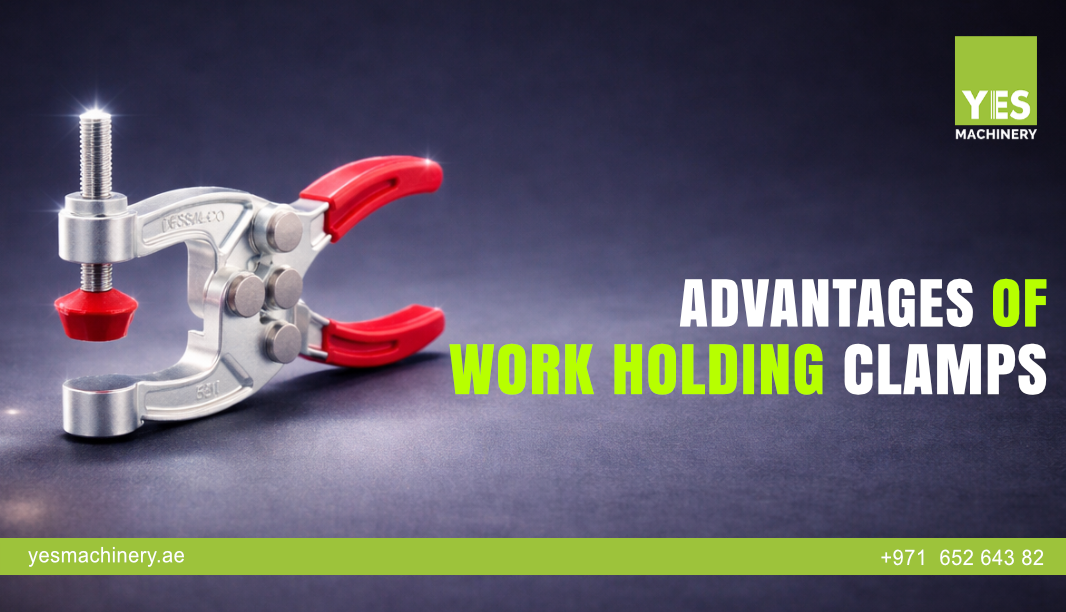
Work Holding Clamps: Advantages for Accuracy, & Efficiency in Manufacturing
- Category Machines
Work holding clamps are important tools in manufacturing industries owing to the fact that these industries work on fabrication, woodworking, and processing which requires securely holding a job piece. These clamps work by stabilizing job pieces and it prevents unwanted movement and offers accuracy, safety, and consistency in production quality in various applications in the industry.
What Are Work Holding Clamps?
Work holding clamps are devices that are mechanical, designed to hold and secure a thing strongly in position while also maintaining, drilling, welding, cutting and assembling. These clamps are also used in industries like metal fabrication, woodworking, automobile manufacturing and also CNC cutting
The main application of these clamps are to keep the material steady during work so that the tools can work safely and promptly. With no proper clamping, the work piece can move or vibrate and it will lead to poor quality, damaged tools and even accidents at the workplace.
Work holding clamps come in different shapes, sizes and mechanisms. These are found in workshops, manufacturing places and assembly lines because their accuracy and stability is important.
1. Types of Work Holding Clamps
Work holding clamps have different types, here are their varieties:
- Toggle Clamps
Toggle clamps use a lever mechanism to lock the thing safely. They are used in assembly places and woodworking operations because they allow quick locking and releasing.
- C-Clamps and Bar Clamps
These are traditional clamps used in woodworking and light fabrication. They give strong grip force and this is good for holding materials during cutting or gluing.
- Hydraulic Clamps
Hydraulic clamps use fluid pressure to give force for clamping. They are used in CNC machines and automated production systems as these machines and systems require consistent pressure and accuracy
- Pneumatic Clamps
Pneumatic clamps work by using air that is compressed. They are used in automated manufacturing places because in these places they are in need of fast clamping and unclamping.
2. How Work Holding Clamps Function
It is good to know how these clamps work and why they are important for industries.
- Clamping Force
Clamps work by giving pressure on the material to hold it strongly against a surface or fixture. The force won't allow the material to shift when machining or fabrication.
- Positioning and Alignment
Many clamps are made into fixtures that align the material in the correct position. This will help to place it with accurate machining and assembly.
- Quick Locking Mechanisms
Modern clamps are made with fast lock systems that allow workers to secure and release things fastly and this improves productivity.
Advantages of Work Holding Clamps
Work holding clamps can give many benefits in manufacturing, processing, and fabrication..
Here are some advantages that make them non replaceable in modern industries.
1. Improved Accuracy
Work holding clamps give improved accuracy and they give during processing and fabrication.
When a material is strongly clamped, it will be completely stable while cutting, drilling and milking operations. This stability will allow the tools to follow the exact program or measured path without having any issue for the manufacturers to get tighter tolerances, better finishes, and higher product quality.
2. Increased Safety in the Workplace
Safety is important in industrial places especially when people work with heavy machinery and sharp tools.Work holding clamps prevent the workpiece from slipping or being thrown by rotating tools. This reduces the risk of accidents or injuries to workers.
By posittioning the materials safely in a place, clamps allow workers to use the machine with increased confidence and control.
3. Higher Productivity
Using work holding clamps increases productivity in work and production places.
Workers can clamp them safely and focus on using the machine. This allows it to be completed faster and more efficiently.
In automated production systems, pneumatic and hydraulic clamps enable faster clamping and releasing and this will increase the operational speed.
4. Consistent Product Quality
Consistency is important in manufacturing as in some industries they produce the same thing over and over again.
Work holding clamps ensure that each material is positioned in the exact same location during every operation. This repeatability will lead to uniform product quality and decrease variations between parts.
Manufacturers can maintain strict quality standards across large production runs.
5. Flexibility Across Multiple Applications
These clamping machines can be used in a lot of industrial and workshop applications.
For example, clamps are commonly used in:
- Metal fabrication
- Woodworking
- Welding operations
- CNC machining
- Assembly processes
Different clamp designs allow them to handle different materials, shapes, and sizes.
6. Reduced Material Damage
Not handling materials correctly can scratch and form dents, deformation in the workplace.
Work holding clamps safely puts pressure that is controlled and it is applied to the material against a surface to not accidentally move it but some clamps have protective pads and soft gripping surfaces to protect thin parts.
This is useful when working with aluminum, glass, or finished components.
7. Better Tool Life
When workpieces move or vibrate during working the cutting tools will get uneven loads and excessive wear.
Clamps prevent this by keeping the material stable. This helps tools cut smoothly and efficiently, which also extends their lifespan.
Businesses can reduce tool replacement costs and maintenance expenses.
8. Support for Automation
Modern manufacturing increasingly relies and works on automation and robotic systems.Work holding clamps will keep the workpieces fixed in precise positions for robotic operations. Hydraulic and pneumatic clamps are particularly suitable for automated production because they can be controlled electronically and integrated with machine systems.
9. Space Optimization in Workstations
Work holding clamps can be integrated into fixtures and workstations and this allows the workers to organize materials more efficiently. By strongly holding the material, clamps don't need the operator's hands and hence reduce clutter on the workspace. This improves workflow efficiency and helps to maintain a clean and organized working environment.
10. Less expensive Manufacturing Solution
Work holding clamps are simple devices, yet they give big cost benefits. By improving accuracy, reducing errors, and preventing material damage, clamps help to reduce waste and rework. They also increase production efficiency, which lowers operational costs for manufacturers.
Conclusion
Work holding clamps are important tools and it can improve accuracy, safety, and productivity in manufacturing and fabrication processes. By safely holding the material in place, they give accurate processing which reduces errors, and supports efficient production operations. As industries continue to move toward automation and high quality standards, the clamps will be important in modern workshops and factories. To avail the best work holding clamps for all your requirements, you may contact YES Machinery - trusted machinery supplier in the Middle East.
Search
Latest Blog
Categories
- Assembly and Lean
- Cleaning Machines
- Cleaning Robots
- Cutting, Notching, Punching
- Edge Preperation
- Grinding Machines
- Industrial Vacuum Cleaners
- Lifting
- Lifting and Manipulation
- Machines
- Marking Solutions
- Metal Forming
- Metal Joining and Fastening
- Packing
- Pipe Handling
- Storage Solutions
- Sweeper Tool Carrier
- Vacuum lifting machine
- Warehousing and Storage
- Welding
Related Blogs